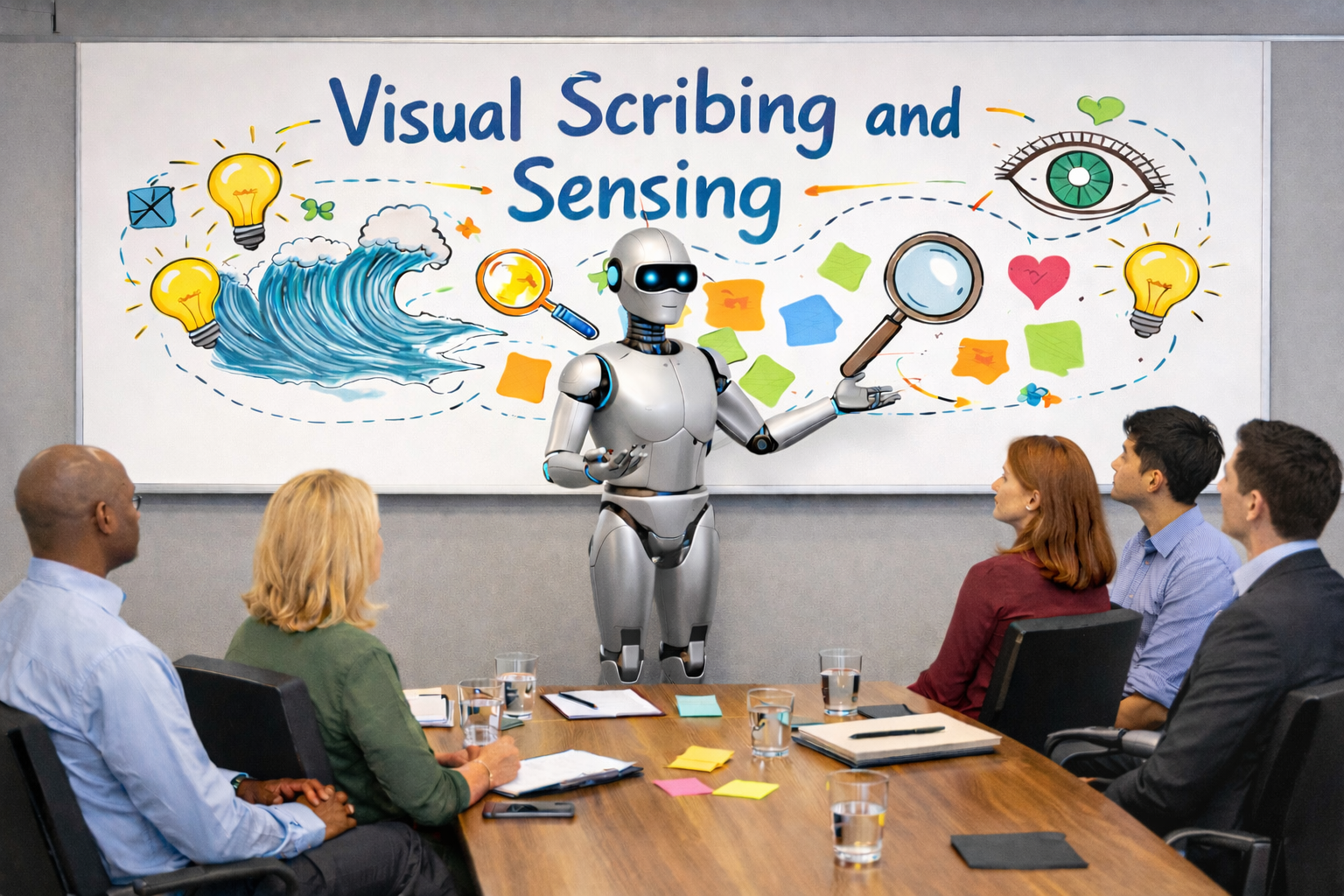
Over a few months last year, the authors of this paper facilitated a strategic-planning exercise for a large corporate business unit (BU) client working in the North American fibre-based packaging industry. The BU was seeking to refine its business strategy, create a new vision for a revamped management team and to position itself as an attractive investment opportunity for Head office.
Strategy consultant Iryna Baturevych explored how AI might enhance the exercise; Oksana Kandabura, a visual artist, used visual sensing and scribing techniques during the sessions to help the strategic-planning team better capture what was happening during them; and Mark Hollingworth, president of 5i Strategic Affairs, concentrated on hosting and facilitation. Although we knew each other, this was our first time working together on a consulting mandate. By collaborating, we sought to enhance the cold, hard data and analysis generated by models and conversations, while also sensing and capturing the equally important “warm/living data” tied to participants, which was ever-changing during the process.
This article aims to explore how AI can help humans better interpret and learn from visual scribing/sensing imagery that is generated during strategic-planning meetings. Three AI tools—Gemini, Claude, and ChatGPT (using the Aiden Cinnamon Tea Sensibility Simulation Protocol 2.0)—were asked during the sessions and afterwards to interpret Kandabura’s artwork from each of the three two-day off-site retreats. Their outputs were merged for this article. We invite you to spend a minute or two observing this work (presented below) before reading the subsequent texts. What do you see/sense? How do you interpret them?
SESSION 1
The introductory session brought together 20-plus team members from several facilities and geographic locations to create a shared intention, complete a diagnostic, and establish the “deep dives” required over the summer.
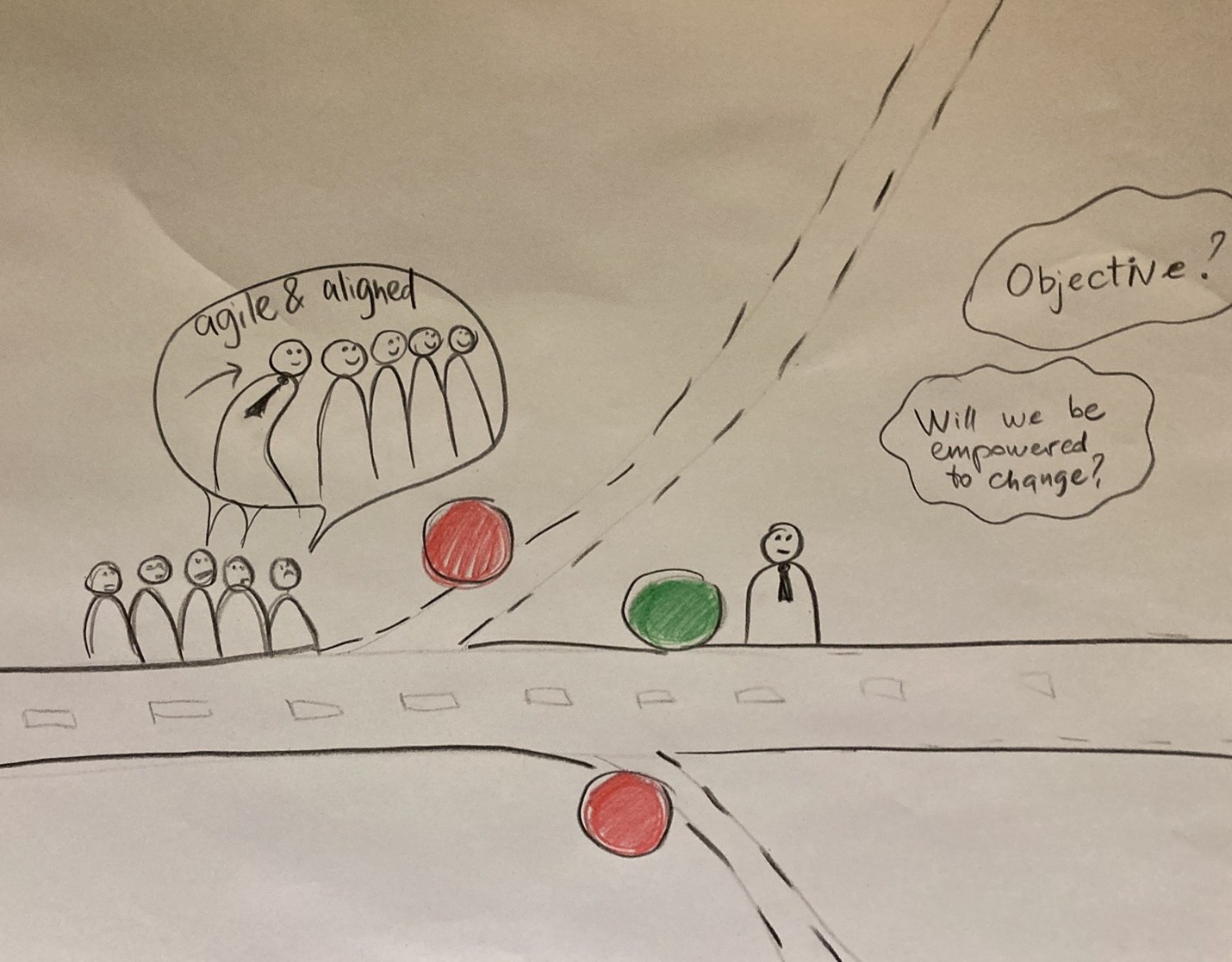
What did the artwork say to us? The team wanted to come together but weren’t there yet; they were aware that their decisions might not be supported by corporate; they had choices from a range of options—some clearer options were better than others; “more of the same” was still on the table; they wanted to come together as one going forward.
How did AI tools interpret the image? This image captures a team at a strategic crossroads—not a straight path but a junction signalling uncertainty, choice, and multiple possible futures. The team framed its first meeting not as refinement of an existing plan, but as redirection.
On the left, a clustered group aspires to be “agile & aligned”; on the right, a lone figure stands apart near a green circle, while red circles appear along the road. The visual creates stark tension: cohesion versus separation, aspiration versus hesitation. The group appears unified but passive—close together but not moving. This may reflect a compliance-versus-commitment gap: the team knows the language of agility but does not yet feel it.
The most emotionally charged elements are the questions: “Objective?” and “Will we be empowered to change?” The lone figure near the green signal may represent leadership or decision rights that feel concentrated rather than shared—hinting at a history of top-down or predetermined planning.
Red circles—more numerous than green—suggest perceived obstacles. The team seems ready but is waiting to see whether the light turns green. This is not misalignment; it is a threshold moment. Psychological safety and genuine empowerment are the real hurdles. Without them, red signals multiply into cynicism. With them, the crossroads becomes momentum.
SESSION 2
In the second session, the team worked on scenario planning and the identification of different visions for how the BU could move forward while Oksana created the following image.
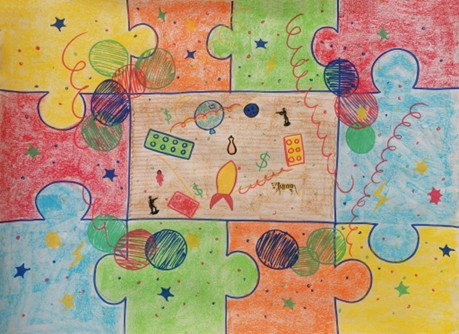
What did the artwork say to us? The image reflects the challenge of building a strategic plan while many pieces remain in motion—inviting patience and the willingness to move forward without complete clarity. At the centre sits a solid brown rectangle representing the company—stable but not a puzzle piece, hinting at the tension between stability and uncertainty. Around it, a vibrant mix of circles, puzzle pieces, stars, and confetti conveys playfulness, creativity, and lively collaboration.
How did AI tools interpret the image? This second image reflects a shift from the first meeting’s anxiety toward energy, integration, and possibility. Interlocking puzzle pieces represent interdependence and diversity—strategy is no longer a straight path but a complex system. The bright colours, spirals, and lightning bolts signal that the team has moved from skepticism toward enthusiasm and psychological safety.
Overlapping circles along puzzle seams highlight cross-functional collaboration: value appears to emerge at the intersections, not within isolated pieces. Yet the centre remains symbol-rich and somewhat chaotic—many ingredients, but not yet a clear narrative. The rocket is ready; its trajectory is still undefined. If the first drawing reflected the anxiety of the unknown, this one expresses the joy of construction.
SESSION 3
The final session focused on in-depth discussion of plausible alternatives, refining the draft “Strategic Temple” (a visual metaphor used to illustrate a company’s strategic plan on a single page).for the BU, and constructing strategic maps for its five facilities, located in different geographic markets across North America.
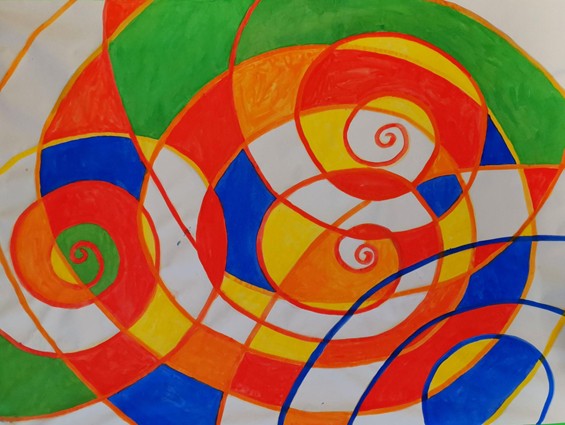
What did the artwork say to us? This piece captures the bright, colourful energy of the team and the dynamic complexity of both the planning process and the Volatility, Uncertainty, Complexity, and Ambiguity (VUCA) environment in which the BU operates. The spirals and intersecting lines suggest ongoing development rather than closure: learning through iteration, revisiting key questions at deeper levels. The team appears to have found a rhythm together. Overall, the image represents energized collaboration, courageous truth-telling, systemic thinking, and a surprisingly clear shared vision emerging from complexity.
How did AI tools interpret the image? This third image shows a further stage: from crossroads (decision) to puzzle (integration) to spiral field (flow). The rigid puzzle borders have dissolved—only flowing, interwoven spirals remain. The familiar colours no longer sit in separate domains; they overlap and blend. The team has moved beyond “we fit together” to “we are intertwined.” Multiple spiral centres may reflect distributed leadership and parallel initiatives. The earlier skepticism has evolved into shared ownership and psychological safety.
Across three meetings the movement is: separation → fitting together → flowing together. At its deepest level, the image feels less like a plan and more like an identity: strategy as patterned movement and shared momentum.
Process Evolution
The journey moves from anxiety and hierarchy → integration and construction → flow and systemic coherence and from questioning voice → assembling purpose → generating shared rhythm. It is a progression not just in strategic clarity, but in the increasing relational maturity of the group. The group stopped negotiating authority and started experiencing collective movement—a team ready not just to execute a plan, but to navigate complexity together with agility and mutual trust.
Ten Lessons Learned
- We used AI post-process and in private to glean the maximum from the images. In the future, we would use AI “in situ”—in front of participants at the end of each session—to provoke deeper discussion, and we would allocate significantly more time to the exercise.
- The main value of the AI tools interpreting each artwork was that they made explicit what was largely implicit to the team members: factors, connections, paradoxes, and irregularities were “put on the table” for all to see, without requiring any individual to have the courage to voice them. They certainly highlighted elements that neither we, as facilitators, nor the participants consciously voiced or noted.
- Although we used three AI models, one may be sufficient. Formats and styles differed, but no single tool proved clearly superior. It comes down to personal preference.
- Simply having someone in the room tasked with sensing the experience in each moment—and capturing it through art—changed the social field in the space, and for the better.
- The major challenge for facilitators is to create an atmosphere of openness, creativity, and (serious) play at the onset that welcomes visual sensing as a legitimate strategic-planning tool. Having someone formally appointed (and highly visible) in that role amplifies that openness.
- It takes courage to introduce visual sensing into corporate decision-making. As with anything new, you must be willing to fail—or learn. Nothing of value may emerge. But you will never know unless you try.
- You do not need artistic talent for visual sensing—although it is obviously an asset. You do need to set aside judgment and allow your hands to move freely. The golden rule: “Never second-guess yourself. If it feels right, let it happen.” There is no good or bad creation (after all, visual scribing/sensing is a form of “brainstorming”).
- When showing the art to the strategic-planning team in order to gather their insights and opinions, it is important for facilitators to emphasize that no comments are “good or bad.” Those with more comfort with “modern art” may offer more insights but an absolute novice may offer a viewpoint that proves invaluable and that no one else could see, feel, or express. They will only do so if they feel comfortable enough to share.
- “Warm data” elements such as buy-in, engagement, motivation, trust, and connection are vital to decision-making and change management, yet tough to capture in KPIs or PowerPoint. Capturing them in works of art may be the only way to articulate them.
- The left side of the brain seeks to understand and control the world in fragments—language, logic, explicit facts. The right side of the brain, excelling at implicit knowledge, ambiguity, paradox, and emotional intelligence, sees the world as an integrated, dynamic system. The left brain is naturally dominant; visual sensing allows the right brain to come to the fore. Perhaps this is what the world needs today.
The “Big” Insight
In the right hands, the use of AI for data collection and analysis at each step of the strategic-planning process and to assist with the creation of the final plan can save a lot of time and create a lot of value. The drawback is that it increases the focus of the strategic-planning team on what the “cold,” hard data and facts might tell them.
In order to expose, include, and highlight the “warm,” soft data that is equally important in the process, we believe that the use of visual sensing will prove essential to counterbalance the “left-brain” dominance and tendency. Never forget that strategic planning is as much a human “change” experience as a rigid exercise in analyzing data.
Perhaps most importantly, the client was happy at the end of the process: The BU d created a shared vision of where the team was going and a roadmap to get there and had attained a high level of buy-in from all participants. “Our hypothesis is that AI, the social arts, and strategic-planning exercises constitute a perfect strategic-planning triad.”
About Author
Mark Hollingworth (M.Eng, EMBA), President of 5i Strategic Affairs, is an expert in strategic leadership who has worked as a management consultant, workshop leader/facilitator, educator, and ontological coach for clients in the profit and not-for-profit sectors for over 30 years. In his mission to help “people, companies and society prepare for sustainable success” Hollingworth acts as process leader, guide, trusted supporter, and, when necessary, devil’s advocate, using his talent and experience to help individuals and organizations make crucial decisions that result in concrete action and change. In Canada, he has worked with industry leaders such as ArcelorMittal, Bank of Montreal, CITI, Cogeco, Dillon Consulting, Edwards LifeSciences, Hydro-Québec, Imperial Tobacco, Kruger Inc., Linamar, Metso, Motorola, Prinoth, Rio Tinto Alcan, Richter, Standard Life, and Telus, and internationally he has worked with individuals and organizations in many countries including Azerbaijan, Bhutan, Costa Rica, Ghana, Guatemala, Kenya, Malaysia, Nigeria, Saudi Arabia, Spain, UAE, the United States, Vietnam, and Zimbabwe. Hollingworth lives in Montreal, Canada, and has lectured and given short-courses in Strategic Planning, Leadership & Innovation at McGill University for over 20 years. He is author of two books: Growing People, Growing Companies: Achieving Individual and Organizational Success in the Knowledge Economy (2003) and Strategic Assumptions: The Hidden Yet Powerful Beliefs That Control Every Decision You Make (2014) and numerous articles. Contact: mark.hollingworth@5istrategicaffairs.com